
Most referral rewards get set the same way: an owner picks a round number that feels generous, prints it on a card, and hopes for the best. Sometimes it works. Usually it either sits there doing nothing because it is too small to notice, or it works a little too well and nobody stops to check whether the new clients are actually paying for themselves.
There is a better way to land on the number, and it takes about ten minutes with a calculator. Here is the math, plus what to hand out once you know your number.
The two failure modes look opposite but come from the same place.
Too small. A $5 credit does not change anyone's behavior. Your clients are not doing arithmetic on it. They are deciding whether recommending you is worth the small social risk of putting their name on it, and $5 does not cover that.
Too big. A $75 reward gets attention, but if a new client is worth $200 to you in a year, you just spent more than a third of that before they sat in the chair. Do that thirty times and you have run a very successful campaign that made you almost nothing.
The right number sits between those, and where exactly depends on numbers only you have.
Not what they spend. What you keep.
Here is a working example for a salon. Swap in your own figures as you go.
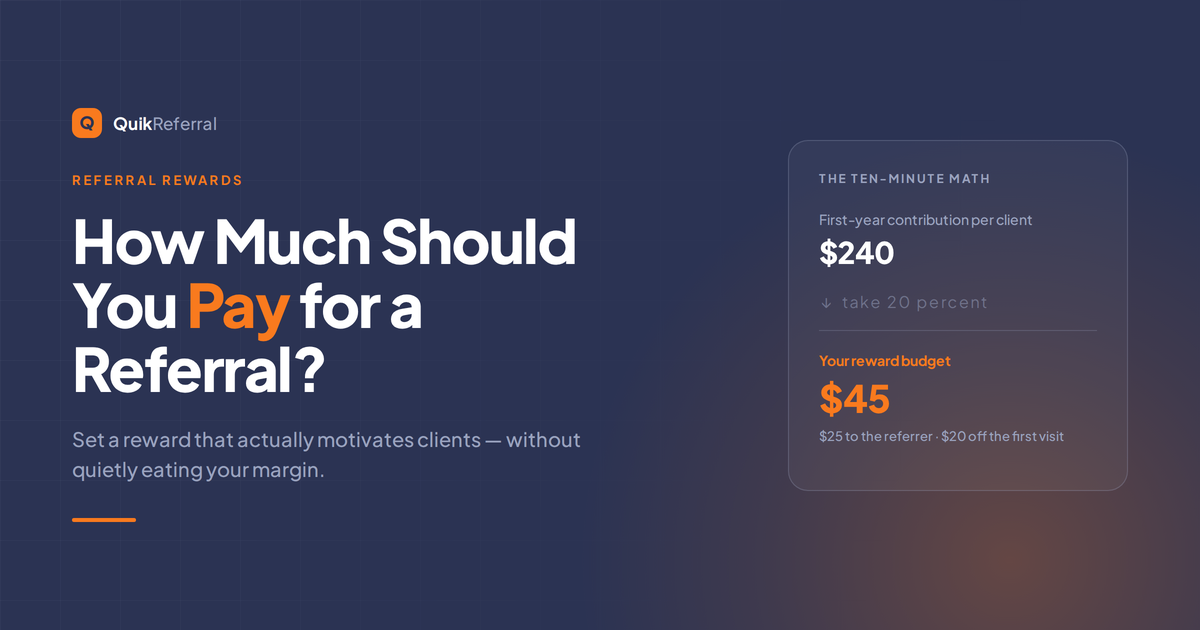
That leaves roughly $240 of first-year contribution from one new client. That is the pool your reward comes out of, and it is a lot smaller than the $510 most people picture when they think about what a new client is worth.
If you own the chair and do the work yourself, take out the product cost and count your own time honestly. If you run booth rental, your number looks completely different and is usually smaller, so run it before you set a reward.
Once you know first-year contribution, the guideline is simple: spend no more than 20 percent of it on rewards, counting both sides of the referral.
In the example above, 20 percent of $240 is about $48. So the total reward budget per successful referral is $48 or less.
That splits comfortably:
Compare that to what you would spend to buy the same client through ads, and it is not close. It is also the only acquisition channel where the money goes to someone who already likes you.
This is the part that changes most people's decision.
A $25 cash payout costs you $25. Full stop.
A $25 service credit costs you what it costs to deliver $25 of service. On the numbers above, that is roughly $11 in stylist pay and $2 in product, so about $13 in real cost as long as you had the chair time anyway. Half price.
A $25 retail product at a standard 50 percent margin costs you about $12.50, and it puts something with your name on it in their bathroom.
So a service credit or a product lets you advertise a bigger number for the same money. That matters, because the size of the number is what gets noticed.
The tradeoff: cash is the most motivating and the least strategic. Credit brings them back through the door, which is the whole point. If your program is not getting traction, try raising the credit amount before you switch to cash.
If you only reward the referrer, you are asking your client to do you a favor. If you only discount the new client, you are running a coupon.
Rewarding both sides changes the conversation entirely. Your client is not asking a friend for a favor, she is handing them something: "Here, you get $20 off your first cut and I get a credit." That is an easy text to send. It removes the awkwardness that stops most referrals before they happen.
Split the budget roughly evenly, and put slightly more on the referrer's side if you want repeat referrals from the same people, or slightly more on the new client's side if you are trying to fill a slow season.
Using the same numbers: one visit generates about $40 of contribution. A $45 total reward is paid back partway through the second visit, and every visit after that is profit.
That is your real test. If a referral does not pay back within the first two or three visits, the reward is too high. If it pays back on the first visit, you probably have room to raise it and get more referrals.
Also worth knowing: referred clients tend to stay longer than clients who found you through a discount, because they came in trusting someone who already trusts you. So the annual number above is usually the conservative version.
The reward is a dial, not a decision. Turn it up when:
Turn it down when the program is producing steadily and you want the margin back. Existing clients rarely notice a reward going from $30 to $25 once the habit is set.
Should the reward be a percentage or a flat amount? Flat. "20 percent off" means different things on different services and nobody can repeat it out loud. "$20 off your first visit" gets remembered and repeated.
What if my average ticket is much higher than $85? Run the same math and pay attention to how often those clients come in. A $300 average ticket at 40 percent contribution keeps you about $120 a visit. If that client comes three times a year, first-year contribution is roughly $360 and a total reward budget around $70 fits. High ticket with low frequency supports less reward than people assume, so do the visits part of the math rather than eyeballing the ticket.
Can I offer a free service instead of a credit? Yes, and it works well when the free service has low delivery cost and high perceived value. A free treatment or add-on is close to ideal. A free full color service is usually more than the math supports.
Do I have to reward every referral forever? No. Many businesses run the program continuously but cap rewards per client per year, or run it hard for a quarter at a time. Just be consistent within whatever window you announce.
Pick your number the boring way. Work out what one new client contributes in a year, take 20 percent of it, split that across both sides of the referral, and pay it in credit rather than cash where you can.
Then the only remaining job is making sure every referral gets caught and every reward gets paid, on time, without anyone having to remember. That is the part software should be doing, not you.
Quik Referral gives every client a unique QR code, tracks who sent who, and handles the reward automatically. 14-day free trial, no app for your clients to download.
Set up your program in minutes. See your first referral within 48 hours.
Start free trial